
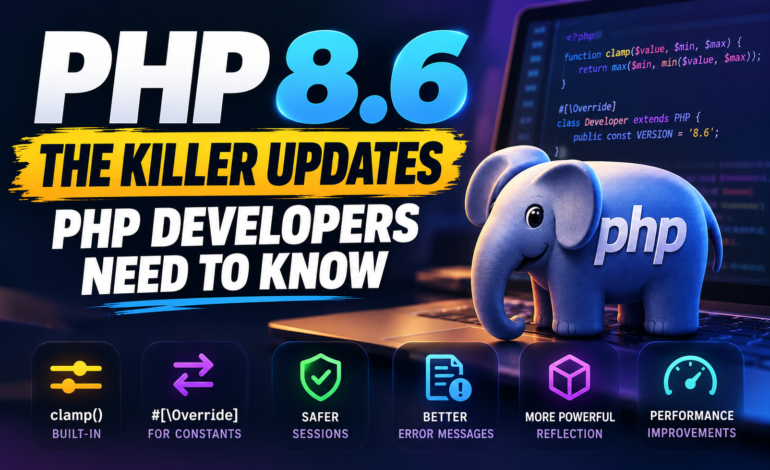

PHP 8.6 Is Coming: The Killer Updates PHP Developers Need to Know
PHP 8.6 is getting close.
The next major PHP release has already reached the release-candidate stage, with PHP 8.6.0 RC2 released on September 24, 2026. The PHP team has another release candidate planned for October 8, so developers are getting very close to seeing the final version.
And there is plenty to talk about.
PHP 8.6 isn’t built around one giant headline feature. Instead, it brings a collection of changes that touch everyday PHP development: cleaner APIs, better reflection, safer sessions, improved security, more useful errors, and several language improvements.
Here are the updates that caught my attention.
1. clamp() Finally Comes to PHP
This might be one of those tiny features that developers end up using all the time.
PHP 8.6 adds a native clamp() function for keeping a value inside a defined range.
$percentage = clamp($value, 0, 100);
If $value is already between 0 and 100, it stays unchanged.
If it’s below 0, you get 0.
If it’s above 100, you get 100.
For example:
clamp(50, 0, 100);  // 50
clamp(-10, 0, 100); // 0
clamp(150, 0, 100); // 100
The function also validates its bounds. An invalid range, such as a minimum greater than the maximum, throws a ValueError.
Developers have been writing their own versions of this for years using min(), max(), or ternary expressions. PHP 8.6 finally gives the pattern a standard implementation.
That may sound small. In real code, small improvements like this add up quickly.
2. #[\Override] Gets Even Better
PHP introduced the #[\Override] attribute for methods in PHP 8.3 and expanded it to properties in PHP 8.5.
PHP 8.6 takes the next step: class constants can also use #[\Override].
Consider this:
class Base
{
    public const STATUS = 'active';
}

class Child extends Base
{
    #[\Override]
    public const STATUS = 'inactive';
}
The attribute makes your intention explicit.
If the parent class doesn’t actually contain the constant you’re trying to override, PHP can catch the mistake instead of silently treating it as an unrelated constant.
For large inheritance-heavy applications and libraries, that extra check can prevent some very annoying bugs.
3. Reflection Gets Much More Useful
PHP 8.6 adds ReflectionProperty::isReadable() and ReflectionProperty::isWritable().
This matters because checking whether a property is public is no longer enough.
PHP now has readonly properties, asymmetric visibility and property hooks, so visibility and actual read/write capability aren’t always the same thing.
With PHP 8.6, reflection-based libraries can ask a much more useful question:
$property->isReadable();
$property->isWritable();
That is particularly useful for frameworks, serializers, dependency injection containers, ORMs and other tools that inspect objects at runtime.
Instead of trying to reconstruct PHP’s property-access rules yourself, reflection can give you the answer.
4. PHP 8.6 Is Getting Serious About Session Security
This is one of the changes I think deserves more attention.
An accepted PHP 8.6 RFC changes the default session configuration for new installations.
The changes affect:
session.use_strict_mode
session.cookie_httponly
session.cookie_samesite
The goal is simple: make safer session behavior the default instead of requiring developers to remember every security-related setting themselves.
session.use_strict_mode helps reject session IDs that PHP did not issue.
session.cookie_httponly prevents JavaScript from accessing the session cookie.
session.cookie_samesite limits when the browser sends the cookie in cross-site requests.
For existing applications, this is worth checking during your PHP 8.6 upgrade because changing defaults can expose assumptions in older code.
For new applications, though, secure defaults are exactly what you want.
5. Better Error Messages for Function Arguments
Debugging PHP errors is about to get a little less frustrating.
PHP 8.6 improves errors and warnings from internal functions by including the arguments that were actually passed to the function.
Imagine code such as:
unlink('/tmp/example.txt');
When something goes wrong, having the actual argument visible in the error message gives you more useful information immediately.
This sounds like a small developer-experience improvement, but anyone who has spent time digging through production logs knows how valuable a little extra context can be.
Good error messages save time.
6. PHP 8.6 Adds a Security Limit to php://filter
This is a more security-focused change.
PHP’s php://filter wrapper can chain stream filters together. Attackers have abused extremely long filter chains in attacks where a local file inclusion vulnerability can potentially be turned into code execution.
PHP 8.6 introduces a limit on the number of filters that can be chained. The default limit is 16.
Developers with legitimate use cases can configure the limit through the stream context.
For most applications, you probably won’t notice this change at all.
That’s a good thing.
Security improvements are often most useful when normal applications don’t need to think about them.
7. Objects Referenced by Constants Become More Flexible
PHP constants themselves remain immutable, but objects are mutable.
PHP 8.6 makes that distinction more practical.
Code like this becomes possible:
const CONFIG = new Config();

CONFIG->enabled = true;
The constant still points to the same object. You’re changing the object’s state, not changing what the constant refers to.
The RFC also covers isset() and unset() in this situation.
This is a relatively specialized language change, but it removes an odd restriction that previously resulted in a fatal error.
8. URI Handling Continues to Grow
PHP 8.5 introduced the new URI extension, giving PHP developers modern APIs for working with RFC 3986 and WHATWG URLs.
PHP 8.6 continues that work.
The accepted URI follow-up adds functionality around:
- URI building
- URI type detection
- host type detection
- percent-encoding
Further work also targets URL path segments and query parameters.
This is important because URL handling is one of those areas where applications often end up relying on a mixture of string manipulation, parse_url(), framework helpers and third-party libraries.
The newer URI APIs are moving PHP toward a more structured approach.
9. Closures Get Some Under-the-Hood Optimization
PHP 8.6 also contains work aimed at making closures cheaper in certain situations.
One optimization can turn a non-static closure into a static one when PHP can prove that it doesn’t use $this.
Another optimization caches stateless closures that don’t capture variables or declare static variables.
You don’t need to rewrite your application to take advantage of this.
That’s the interesting part.
The engine can optimize certain closure patterns automatically.
The RFC does note that these optimizations involve theoretical backward-compatibility considerations, so developers working on unusual closure behavior should still test their applications carefully.
10. grapheme_strrev() Fixes a Unicode Problem
Here’s a feature that looks simple until you try it.
PHP 8.6 adds:
grapheme_strrev()
It reverses a string by grapheme clusters rather than simply reversing individual bytes or Unicode code points.
That distinction matters for modern Unicode text.
For example, an emoji can consist of multiple code points but visually represent one character.
A normal string reversal can split those sequences apart.
grapheme_strrev() understands grapheme clusters, making it much more suitable for user-facing Unicode text.
11. PHP 8.6 Also Has Some Deprecations You Should Know About
New features get most of the attention, but upgrade work isn’t only about what’s new.
PHP 8.6 also introduces deprecations that developers should check before upgrading.
Among them are:
- returning from a
finallyblock - using
letas an identifier - using
in,out, andinoutas identifiers - using
isas an identifier - naming a function
readonly - certain uses of
_ - other syntax being reserved for future language features
Some of these are intended to become errors or disappear in PHP 9.
If you’re maintaining a large application, running your test suite with deprecation reporting enabled is a smart move before the upgrade.
12. PHP 8.6 Raises Some Minimum Build Requirements
PHP 8.6 isn’t just changing the language.
The supported software stack is moving forward too.
The accepted minimum-version RFC includes newer build requirements and minimum versions for MySQL and MariaDB. It specifies Autoconf 2.71 and minimum database versions of MySQL 5.7.3 and MariaDB 10.2.4 for the relevant support changes.
This matters more if you compile PHP yourself or maintain custom server images.
For normal users running distribution packages, Docker images or managed hosting, the hosting provider will usually handle much of this.
Still, it is something to know before upgrading a production server.
What About PHP Context Managers?
One of the more exciting PHP 8.6 ideas is the proposed using syntax for context managers.
The idea looks like this:
using (file_for_write('file.txt') => $fp) {
    fwrite($fp, 'Hello');
}
The context manager would guarantee cleanup when execution leaves the block, including when an exception occurs.
That could make resource management and transaction-style code much cleaner.
However, there’s an important catch:
Context managers are not something you should currently advertise as a confirmed PHP 8.6 feature.
The RFC is still listed as In Discussion, so it should be treated as a proposal rather than a guaranteed part of the final release.
This distinction matters when writing about an upcoming PHP release.
PHP 8.6 Isn’t Just About New Syntax
That’s probably the most interesting thing about this release.
There isn’t a single feature that completely changes how PHP applications are written.
Instead, PHP 8.6 is polishing a lot of rough edges.
You get a native clamp() function.
Reflection becomes more useful.
#[\Override] covers class constants.
Session defaults become safer.
Error messages become more informative.
The URI APIs keep growing.
The engine gets closure optimizations.
Unicode handling gets another useful function.
And several security and compatibility improvements are happening underneath the surface.
That’s the kind of release that can make a language nicer to work with every day.
Should You Upgrade to PHP 8.6?
Eventually, yes—but don’t rush a production upgrade while PHP 8.6 is still a release candidate.
The PHP project explicitly warns that release-candidate builds are for testing and should not be used in production.
If you maintain a serious application, start testing now.
Run your automated tests.
Check deprecation warnings.
Test your framework and third-party packages.
Review database compatibility.
Test sessions and authentication.
And pay particular attention to code that relies on unusual language behavior.
By the time PHP 8.6 reaches its stable release, you want your application to be ready rather than discovering compatibility problems after deployment.
The Bottom Line
PHP 8.6 looks like a release built around making PHP a little better everywhere.
Some changes are tiny.
Some are security-focused.
Some will only matter to framework and library authors.
But put them together and you get a PHP release that should feel cleaner, safer and more pleasant to develop with.
And with PHP 8.6.0 already in the release-candidate phase, this isn’t some distant roadmap anymore.
It’s almost here.
PHP developers should start testing now.
This article reflects the PHP 8.6 development status available on September 29, 2026. Features marked as proposals may still change or be removed before the final release.



Leave a Reply